
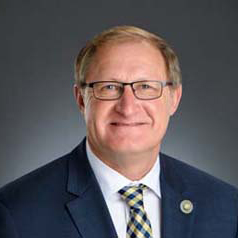
Mike Reese — Senate - District 30
Votes Like
Live from the 2025 Regular Session
(658 Senate floor votes analyzed - so far...)



Upcoming Committee Hearings
Sponsored Bills

SB73: Provides for sequestration of carbon dioxide. (8/1/25)
Last Action: Effective date 8/1/2025.
Date: 2025-06-20
Author: Mike Reese (R)
Co-sponsors: Beryl Amedee (R) Rhonda Butler (R) Dodie Horton (R) Danny McCormick (R) Charles Owen (R) Rodney Schamerhorn (R)
...and 1 more.
📅 Not Scheduled

SB231: Provides for recoverable medical expenses. (1/1/26)
Last Action: Effective date 1/1/2026.
Date: 2025-06-30
Author: Mike Reese (R)
📅 Not Scheduled
Revises rules for recovering past medical expenses in civil litigation, repealing the current 40% markup provision and allowing more flexible evidence for determining medical damages.
Key Provisions:
- Repeals the current formula that limits recoverable past medical expenses to the amount actually paid plus 40% of the difference between billed and paid amounts.
- Allows recovery of amounts actually paid or owed, and the amount billed can be considered as evidence of reasonableness.
- Admissible evidence may now include agreements between providers and third-party payers or collectors.
- Maintains limits on recovery in Medicaid and workers' compensation cases.
- Excludes medical malpractice cases from application.
- Applies only to causes of action filed on or after January 1, 2026.
Purpose:
Provides a broader and more transparent framework for determining medical damages in court, allowing juries and judges to consider both billed and paid amounts to assess reasonable value.

SB59: Provides for fiscal and economic impact statements under the Administrative Procedure Act. (8/1/25) (EN SEE FISC NOTE GF EX)
Last Action: Effective date 8/1/2025.
Date: 2025-06-08
Author: Mike Reese (R)
📅 Not Scheduled
SENATE floor amendments [LINK] clarify that if a proposed rule is tied to legislation with an existing fiscal note, that cost won’t count as a new fiscal impact. They also lower the threshold for legislative review of proposed rules with economic impact from $1 million over five years to $600,000 over three years. Such rules now require approval from a legislative oversight subcommittee unless the subcommittee fails to act within 30 days and the governor approves the rule.
SENATE committee amendments technical in nature
Proposes amendments to the Administrative Procedure Act concerning fiscal and economic impact statements for standard and emergency rulemaking processes.
Key Provisions:
- Enhanced Fiscal Impact Statements: The bill mandates that the Legislative Fiscal Office provide detailed statements on the fiscal and economic impacts of proposed rules, specifying the extent of financial implications.
- Legislative Oversight for Significant Rules: For proposed rules anticipated to result in state expenditures or economic impacts of $200,000 or more annually, or $1 million over five years, approval from the relevant House and Senate subject matter committees is required before enactment.
- Emergency Rule Procedures: Agencies adopting emergency rules must include a fiscal impact statement from the Legislative Fiscal Office. If such rules meet the financial thresholds mentioned above, they necessitate a hearing and approval by the appropriate legislative committees.
- Governor's Review: The Governor retains the authority to review emergency rules within 60 days of adoption. For rules exceeding the specified financial thresholds, the Governor must provide a written explanation detailing the emergency's nature and justification for the rule's immediate effect.
These amendments aim to ensure greater legislative oversight and transparency regarding the fiscal and economic impacts of administrative rules.

SB162: Provides relative to the collection and administration of sales and use taxes. (gov sig) (EN SEE FISC NOTE SD EX See Note)
Last Action: Effective date 7/1/2025.
Date: 2025-06-20
Author: Mike Reese (R)
📅 Not Scheduled
SENATE floor amendment technical
Updates and clarifies Louisiana’s sales and use tax laws regarding remote sellers, marketplace facilitators, and digital products.
Key Provisions:
- Redefines “dealer” to include businesses with virtual or economic presence in Louisiana.
- Updates definitions to replace “products transferred electronically” with “digital products.”
- Requires remote sellers and marketplace facilitators exceeding $100,000 in Louisiana sales to register and collect state and local taxes.
- Authorizes vendor compensation deductions for timely tax filings, applied per jurisdiction.
- Removes rental car facilitators from the definition of “marketplace facilitator” (clarifies travel agencies or apps assisting in renting cars would not be responsible for collecting sales tax, reverts to rental car companies)
- Clarifies that once a marketplace facilitator crosses the $100,000 threshold, it must collect tax on all future sales.
- Effective upon governor’s signature.
SB186: Provides relative to the New Markets tax credit. (gov sig) (EN -$22,500,000 GF RV See Note)
Last Action: Effective date 6/20/2025.
Date: 2025-06-20
Author: Mike Reese (R)
Co-sponsors: Steven Jackson (D)
📅 Not Scheduled
We are trying to eliminate tax credits to lower income and corporate taxes. Why are we creating new LARGE tax CREDITS like this?
SENATE floor amendments [LINK] require qualified community development entities to annually report detailed investment information, including business descriptions, investment amounts, employment data, and local economic indicators, for investments made after August 1, 2025. Entities are exempt from reporting investments already redeemed or repaid.
SENATE committee amendments [LINK] narrow eligible business sectors, adjusting investment caps ($10M before 2020, $5M from 2020–2025, $10M after 2025), and requiring certification that applicants haven’t forfeited prior deposits. It authorizes $150M in new investment authority starting August 1, 2025, allows partial awards, and mandates a $500,000 deposit unless the applicant has a clean compliance record.
***$22.5 MILLION IN TAX CREDITS***
Makes technical adjustments to the New Markets tax credit program, updating timelines and credit percentage phases for equity investments.
Key Provisions:
- Changes the credit schedule for investments issued on or after August 1, 2020:
- 15% credit applies in years 3–5 (instead of 4–6).
- 10% credit applies in year 6 (instead of year 7).
- Updates deadlines for investing the capital from qualified equity investments:
- Investments issued before August 1, 2020, or after August 1, 2025: must invest within 1 year.
- Investments issued between August 1, 2020, and August 1, 2023: must invest within 9 months.
- Effective August 1, 2025.

SB243: Provides relative to the sales and use tax exemption for the sale of certain prescription drugs. (gov sig) (EN SEE FISC NOTE LF RV See Note)
Last Action: Effective date 6/11/2025.
Date: 2025-06-11
Author: Mike Reese (R)
📅 Not Scheduled
SENATE committee amendments technical in nature.
Clarifies that prescription drug sales to individuals enrolled in any Louisiana Medicaid or CHIP program are exempt from state and local sales and use taxes.
Key Provisions:
- Amends R.S. 47:305.2(B)(1) to clearly state that the exemption applies to all enrollees in Medicaid (Title XIX) and CHIP (Title XXI) programs.
- Specifies that this change is interpretive, not substantive—it restates existing law without creating new rights or duties.
- Becomes effective upon the governor’s signature.
SB72: Provides relative to the issuance of bonds for financing certain capital improvement projects within the Louisiana Community and Technical College System. (2/3-CA7s6(A))(7/1/25) (EN SEE FISC NOTE SD EX See Note)
Last Action: Effective date 7/1/2025.
Date: 2025-06-04
Author: Mike Reese (R)
Co-sponsors: Adam Bass (R) Joseph Bouie (D) Patrick Connick (R) Franklin Foil (R) Samuel Jenkins (D) Eddie Lambert (R) W. Jay Luneau (D) Beth Mizell (R) William Wheat (R) Daryl Adams (D) Mike Bayham (R) Beth Billings (R) Ken Brass (D) Dewith Carrier (R) Kellee Dickerson (R) Kathy Edmonston (R) Adrian Fisher (D) Steven Jackson (D) Ed Larvadain (D) Denise Marcelle (D) Charles Owen (R) Rodney Schamerhorn (R)
...and 17 more.
📅 Not Scheduled
SENATE floor amendments technical
SENATE committee amendments [LINK] remove the requirement that matching funds must be "private." Allows the fair market value of donated property to count as matching funds. Sets the effective date of the Act as July 1, 2025.
This bill amends Louisiana law on funding construction and improvement projects at community and technical colleges (LCTCS). It keeps the existing limit of $43.9 million per year for repaying debt from bonds issued to build LCTCS facilities. The bill specifically authorizes new projects, such as campuses for Northshore Technical Community College in Hammond and River Parishes Community College in Donaldsonville. Each new project must secure at least 12% matching funds from non-state sources before receiving state financing. It also requires the LCTCS board to regularly assess the conditions and priorities of campus buildings.
SB82: Provides with respect to ad valorem taxes on shares of bank stock. (1/1/26) (EN DECREASE LF RV See Note)
Last Action: Effective date 1/1/2026.
Date: 2025-06-08
Author: Mike Reese (R)
📅 Not Scheduled
Eliminates ad valorem taxes on stock for banks. SEE FISCAL NOTE for possible increase in revenue in "Revenue Explanation" section [LINK]
Proposes changes to the assessment of ad valorem taxes on bank stock in Louisiana. Currently, bank stock is taxed based on 15% of its fair market value, with a deduction of 50% of the assessed value of real estate, improvements, buildings, furniture, and fixtures owned by the bank. The bill seeks to increase this deduction from 50% to 100%, effectively reducing the taxable amount of bank stock. If enacted, this change would take effect on January 1, 2026.
This change aims to prevent double taxation on bank-owned properties and could lead to a reduction in property tax liabilities for banks, potentially influencing their financial strategies and investment decisions. The proposed amendment is set to take effect on January 1, 2026, impacting property taxes for the 2026 tax year.
It's considered by the banks to be double taxation because banks already pay property taxes on their real estate, buildings, furniture, and fixtures. When their shares of stock are assessed for ad valorem tax, the value of these same tangible assets is indirectly included in the bank’s overall valuation—which is used to determine the tax on those shares.
So essentially:
1. First layer of tax: The bank pays direct property tax on its buildings, land, and equipment.
2. Second layer of tax: The shareholders are taxed again on the value of the bank’s stock, which reflects (in part) the value of those already-taxed assets.
By allowing banks to deduct 100% of the value of these tangible assets when calculating the taxable value of their stock, the bill aims to eliminate that second, overlapping layer of taxation on the same property.
Several states impose specific taxes on financial institutions, though the methods and rates vary. Here's a comprehensive list:
· California: Financial corporations are subject to a corporate income tax at a rate of 10.84%, higher than the standard 8.84% for other corporations.
· Georgia: Imposes an occupation tax on depository financial institutions conducting business or owning property in the state. These institutions are also subject to corporate income and net worth taxes but receive a dollar-for-dollar credit against these taxes based on their occupation tax liability.
· Illinois: Defines "financial organizations" to include entities like small loan companies and investment companies, subjecting them to specific tax regulations.
· Indiana: Subjects financial institutions to a financial institutions tax, with mandatory combined reporting for unitary groups.
· Ohio: Imposes a financial institutions tax based on a bank's Ohio equity capital.
· Pennsylvania: Imposes a Bank and Trust Company Shares Tax on every bank and trust company conducting business in the state. The tax is levied annually based on the value of shares as of January 1, with the taxable value determined by the institution's total bank equity capital, adjusted for certain deductions.
· South Carolina: Levies a separate income tax on banks operating within the state, with its own income and deduction provisions.
· Tennessee: Imposes the Hall income tax on interest and dividend income received by residents, which includes dividends from bank stocks.
These examples illustrate that while the taxation of financial institutions is not uniform across the United States, multiple states have implemented specific tax regimes targeting these entities.
SR103: Commends the members of the Louisiana Automobile Dealers Association (LADA) and to designate Tuesday, May 13, 2025, as Louisiana Automobile Dealer Day at the Louisiana State Capitol.
Last Action: Enrolled. Signed by the President of the Senate and sent to the Secretary of State by the Secretary of the Senate.
Date: 2025-05-14
Author: Mike Reese (R)
📅 Not Scheduled
SR192: Requests the Senate Committee on Judiciary B to study recent technological advancements regarding lotteries and determine whether such advancements conform with Louisiana law.
Last Action: Enrolled. Signed by the President of the Senate and sent to the Secretary of State by the Secretary of the Senate on 6/13/2025.
Date: 2025-06-12
Author: Mike Reese (R)
📅 Not Scheduled
Proposes an amendment to R.S. 30:1105(C) concerning carbon dioxide sequestration. The current law allows any interested person to request a hearing with the commissioner by submitting a written request and paying a fee. Upon receiving such a request, the commissioner is required to promptly call a hearing and take appropriate action within 30 days of its conclusion. The bill's primary objective is to ensure that the commissioner of conservation gives substantial consideration to comments from local governments when deciding on matters within their jurisdiction. This amendment emphasizes the importance of local government input in the decision-making process related to carbon sequestration projects. The bill is set to become effective on August 1, 2025.