
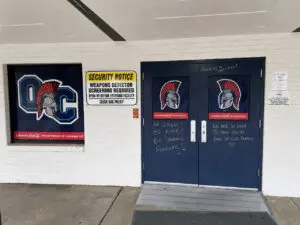
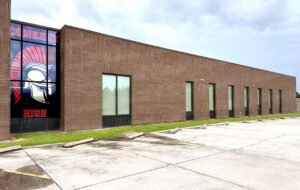
Citizens for a New Louisiana has long argued that Lafayette Parish does not suffer from a revenue problem. It suffers from a priorities problem. The closure of Ovey Comeaux High School may be the most visible consequence of those priorities yet.
At the very moment Ovey Comeaux High School was earning its first “A” rating, recording the most academic growth in the district, and being voted Acadiana’s Best High School, the school system was preparing to close it.
Comeaux High graduates are understandably furious. One of Lafayette Parish’s most historic and beloved schools now faces closure and repurposing. This has sparked fierce opposition from alums and community members, many of whom are now fighting to preserve one of Lafayette Parish’s most storied high schools. Their concerns are understandable. For many families, Comeaux High is more than a campus. It is part of their identity and heritage.
Yet what makes this moment particularly painful is that many residents warned about this possibility years ago.
2017 — A Year To Remember
 Back in 2017, Lafayette Parish voters were presented with a nearly $200 million school construction proposal. The public campaign was emotionally compelling. Mailers showed children walking through the rain between temporary classrooms and warned of overcrowding and deteriorating facilities. The message was simple: our schools need more space, and we have to build.
Citizens for a New Louisiana had a question. Do we?
At the time, we obtained records from the school system itself. Those records showed that Lafayette Parish schools had capacity for more than 40,000 students while enrolling fewer than 30,000. More than 11,000 seats sat empty throughout the system.
The issue was not an absence of buildings. The issue was how existing buildings were being used. We said so at the time. The voters agreed. By a margin of nearly 60-40, they rejected the tax proposition.
Facts Are Stubborn Things
 There is one fact that makes this entire episode difficult to dismiss as mere changing circumstances. Since at least 1999—the earliest years for which enrollment records are readily available—Lafayette Parish’s student population has remained remarkably stable. The number has hovered around 30,000 students for more than a quarter century.
Administrations changed. School boards turned over. Buildings were constructed. Hundreds of millions of dollars were spent. Yet the student count stubbornly remained where it had always been—right around 30,000. Somehow, with essentially the same number of students, the district arrived at two entirely opposite conclusions. In 2017, taxpayers were told there was not enough capacity. In 2026, taxpayers are being told there is too much. Time marched on, but the enrollment numbers did not.
Yet The Story Did Not End There
The school system ultimately found a way to pursue much of its desired construction anyway. New capacity was built in Youngsville, as Southside High School. Students migrated. Attendance patterns changed. Legacy schools like Comeaux High increasingly found themselves competing with newer facilities.
Now, nearly a decade later, the school system says it cannot continue maintaining excess capacity. And Ovey Comeaux High School has become the latest casualty. This is not an argument against growth, nor is it an argument against every capital project. Communities change, and school systems must adapt.
However, it is impossible to ignore the contrast. In 2017, taxpayers were told Lafayette Parish desperately needed additional capacity. In 2026, taxpayers are being told Lafayette Parish has too much capacity. The difference between those two statements is not merely the passage of time. The students did not disappear. The enrollment remained remarkably consistent. Between those contradictory statements lie millions of dollars in capital spending, the construction of Southside High School, and the gradual migration of students away from legacy campuses such as Comeaux High.
That is not merely unfortunate. It is remarkably close to the very concern many residents expressed years ago. Perhaps the most frustrating part of this story is that many of the officials making today’s difficult decisions were not the officials who made the decisions that helped create these problems. School boards change. Administrations change. Priorities shift.
The Consequences, However, Remain
Buildings last for generations. Debt lasts for decades. Communities remember. Comeaux High School is not merely another collection of classrooms. It is the home of the Spartans, an alma mater shared by parents, children, and grandchildren. It is Friday nights, graduation ceremonies, and lifelong friendships that span generations of Lafayette families. The school system may view Comeaux High as excess capacity. Its graduates view it as part of their identity.

Its closing feels less like an isolated policy decision and more like the final chapter of a story that began years ago. A school system that was warned it had a utilization problem spent years pursuing additional capacity anyway. The result is not a school system serving substantially more students. It is a school system that serves roughly the same number of students across different buildings. Now, facing the consequences of those new construction decisions, it proposes eliminating the capacity that once served generations of students.
Comeaux High School is not closing because Lafayette Parish suddenly lost thousands of students. It didn’t. It’s closing after years of decisions that rearranged where students would attend school and how the system chose to deploy its resources. For more than twenty-five years, Lafayette Parish has educated approximately 30,000 students. Time marched on. The enrollment number did not.
We have said for years that Lafayette Parish does not have a revenue problem. It has a priorities problem. The debate surrounding Comeaux High School may be the most expensive lesson yet.
###
Facts First. Even When They’re Inconvenient.

Some outlets or groups tell you what to think. Others have discovered there’s an easier way to build an audience: tell people exactly what they want to hear. We’ve chosen a harder path.
At Citizens for a New Louisiana, we start with the evidence — public records, financial disclosures, court filings, voting records, audits, and original documents — and follow it wherever it leads. Sometimes the facts confirm what we expected. Sometimes they surprise us. Sometimes they disappoint our friends. Either way, we publish them.
That approach doesn’t always produce the loudest headlines or the easiest fundraising. But over time, it produces something much more valuable: TRUST. If you value independent Louisiana journalism that puts evidence ahead of outrage and principle ahead of tribe, please help us continue the work.
Become a Monthly MemberContribute $10 NowMake a Tax Deductible Gift
Already have a donor-advised fund? Ask your DAF administrator about recommending a grant to New Louisiana Foundation.


Honestly, I’m not sure of the point you are making here? What priority’s were misplaced? Enrollment of Comeaux went from 2,041 in 2016 to under 900 by 2026. Seems as though shifting demographics are responsible. I’m guessing that trend is true for most older schools in Lafayette? Is that so? So I guess that means more building in new areas and ending funding in locations losing population is the only way to balance the budgets? Unless they had increased budget to built new schools in declining areas, I not sure what other decision they could have made? Maybe you can clarify your suggestion of misplaced priorities?
Sounds like a money grab. LCG. Pulled in $250 more dollars under this current Democrat Mayor President and rolls the property taxes forward, for MORE. The schools, the libraries, are just honey holes for local government.