
Police officers are routinely told to follow the chain of command. When a problem arises, document it. Attempt to resolve it at the lowest possible level. Use the established process. Escalate up the chain. File a grievance. Allow the department an opportunity to address the complaint internally.
But what happens when an officer does exactly that — and the process goes nowhere?
That is one of the questions now before the Youngsville Municipal Police Civil Service Board following a Petition for Investigation filed by Detective Tyra Dorsey. The petition, verified by Dorsey on August 25, 2026, asks the Civil Service Board to investigate a series of events involving her treatment within the Youngsville Police Department. The allegations include an unresolved internal grievance, an anonymous letter sent to schools where Dorsey was assigned for a few hours, evidence allegedly connecting that letter to a member of police command, and Dorsey’s subsequent transfer out of the Criminal Investigations Division.
An Internal Grievance That Never Really Ended
According to the petition, Dorsey filed a written grievance against Assistant Chief of Police Kenny Duhon on April 15, 2026. The grievance involved, among other things, Duhon spreading what Dorsey describes as a false personal rumor concerning her alleged relationship with another officer, Clay Durke.
The grievance then moved through the department’s internal process. According to Dorsey, Chief J.P. Broussard initially advised her that Duhon had received verbal counseling. Dorsey rejected that resolution and asked that the matter be addressed further, including identifying who Duhon claimed had provided the false information he was maliciously circulating.
Broussard later returned the grievance stating that prior action had been taken and that Duhon had advised he had “heard it on the street.” Dorsey again rejected that disposition. The matter was then elevated to Mayor Ken Ritter. Ritter ultimately wrote that the matter should be “referred to the civil service board” because he lacked authority to intervene in personnel matters under Chief Broussard’s purview.
Detective Dorsey followed the internal grievance process. When she remained dissatisfied with Chief Broussard’s response, the matter ultimately reached Mayor Ken Ritter. The mayor directed that it be taken to the Civil Service Board. When that apparently did not happen, Dorsey filed the petition herself. The process has now reached the body empowered to investigate. What happens next is no longer up to Dorsey.
The City itself provided further confirmation that Dorsey had filed complaints with the administration. In a September 25, 2026 response to a public records request submitted on July 10, 2026, seeking complaints filed by Dorsey, City Attorney K. Wade Trahan acknowledged that the City possessed responsive documents but stated that the City was withholding them.
The Anonymous Letter
The petition describes another troubling development. On June 2, 2026, the principal of Acadiana Renaissance Charter Academy Middle School reportedly received an anonymous letter accusing Dorsey of abandoning her School Resource Officer assignment on March 17, 2026, without permission or replacement and leaving students and teachers unprotected.
According to the petition, substantially similar letters were sent to multiple schools in the area. Dorsey began looking into where the letters came from. Her petition says the envelope was mailed using an ordinary commercial stamp rather than the metered postage the Mayor’s office confirmed was normally used for official City and police correspondence. They also contained a return address of “201 Iberia” — the location of Youngsville City Hall and Police Department. More significant was the printer history.
The petition alleges that a shared office printer accessible to command personnel showed Assistant Chief of Police Kenny Duhon printing seven copies of a document from his Outlook inbox at 4:54 a.m. on May 27, 2026. Seven copies.
According to the petition, that corresponds with the number of letters subsequently mailed. Dorsey also alleges the anonymous letter contained non-public information concerning the March incident and its internal handling — information that would have been available only to a limited group within the department, as it was part of a confidential internal investigation.
The petition says Chief Broussard was presented with the evidence and would authorize an Internal Affairs investigation only if Dorsey could “get proof it came from within the department.” That presents something of a circular problem. Investigations are generally how evidence is discovered and becomes proof. Any law enforcement officer should know that. If an officer must first prove misconduct occurred before an investigation can begin, it becomes difficult to understand what purpose an investigative process serves.
One Day
The second major issue presented in the petition concerns Dorsey’s transfer from Criminal Investigations to Traffic. According to the filing, Dorsey submitted a formal complaint to the City’s Human Resources Department on July 2, 2026.
Then, on July 9, 2026, Mayor Ken Ritter advised Chief Broussard, before a City Council meeting, that Dorsey had filed a Human Resources complaint and cautioned him against taking any action that would be or could be perceived as retaliatory. Mayor Ritter submitted this to Chief Broussard in writing the next day.
The next day, July 10, 2026, Assistant Chief Duhon removed Dorsey from the Criminal Investigation Unit. Chief Broussard ordered the removal, and Assistant Chief Duhon reportedly attributed the transfer to Dorsey’s ‘inability to follow directions’ and ‘never being where she is supposed to be located.’ Dorsey disputes that characterization and contends the justification conflicts with the department’s own March 17, 2026 investigation.
We have requested the contemporaneous investigative record that could help test those competing accounts, but it also has been withheld without explanation. On June 12, 2026, a public records request sought the complete investigative file concerning a department investigation of Dorsey, initiated around March 26, 2026, involving allegations of “neglect of duty.” That file is particularly relevant because Dorsey contends the department’s own investigation conflicts with the justification later offered for removing her from CID. Without the underlying records, that assertion — like several others now before the Civil Service Board — has yet to be tested against the department’s contemporaneous documentation.
No Public Records For You
On July 13, 2026, the attorney handling Broussard’s response indicated that she needed to determine the matter’s procedural standing before deciding whether the records were subject to disclosure, as she understood Dorsey had appealed the discipline. Two days later, on July 15, the Civil Service Board declined to consider Dorsey’s appeal as timely, and we notified the attorney that same evening. Yet the investigative file still has not been produced. More importantly, no written determination identifying a statutory basis for withholding the record has been provided. Louisiana law requires a custodian who determines that a requested record is exempt from disclosure to provide the requester with the reasons for that determination and identify the legal basis for the claimed exemption. Chief Broussard has provided no lawful basis for doing so, yet continues to withhold the record. Why?
Perhaps it has something to do with a separate concern raised involving allegations about Chief Broussard’s conduct toward employees of a local business, Prejean’s Tag and Title. Those allegations remain unproven, but photographs place Broussard at the location, and text messages provide additional context about an issue circulating within the department. Maybe the couch is just cozier at Prejean’s Tag and Title. However, the situation was one Dorsey was aware of and allegedly raised during her investigative testimony.
Another Removal
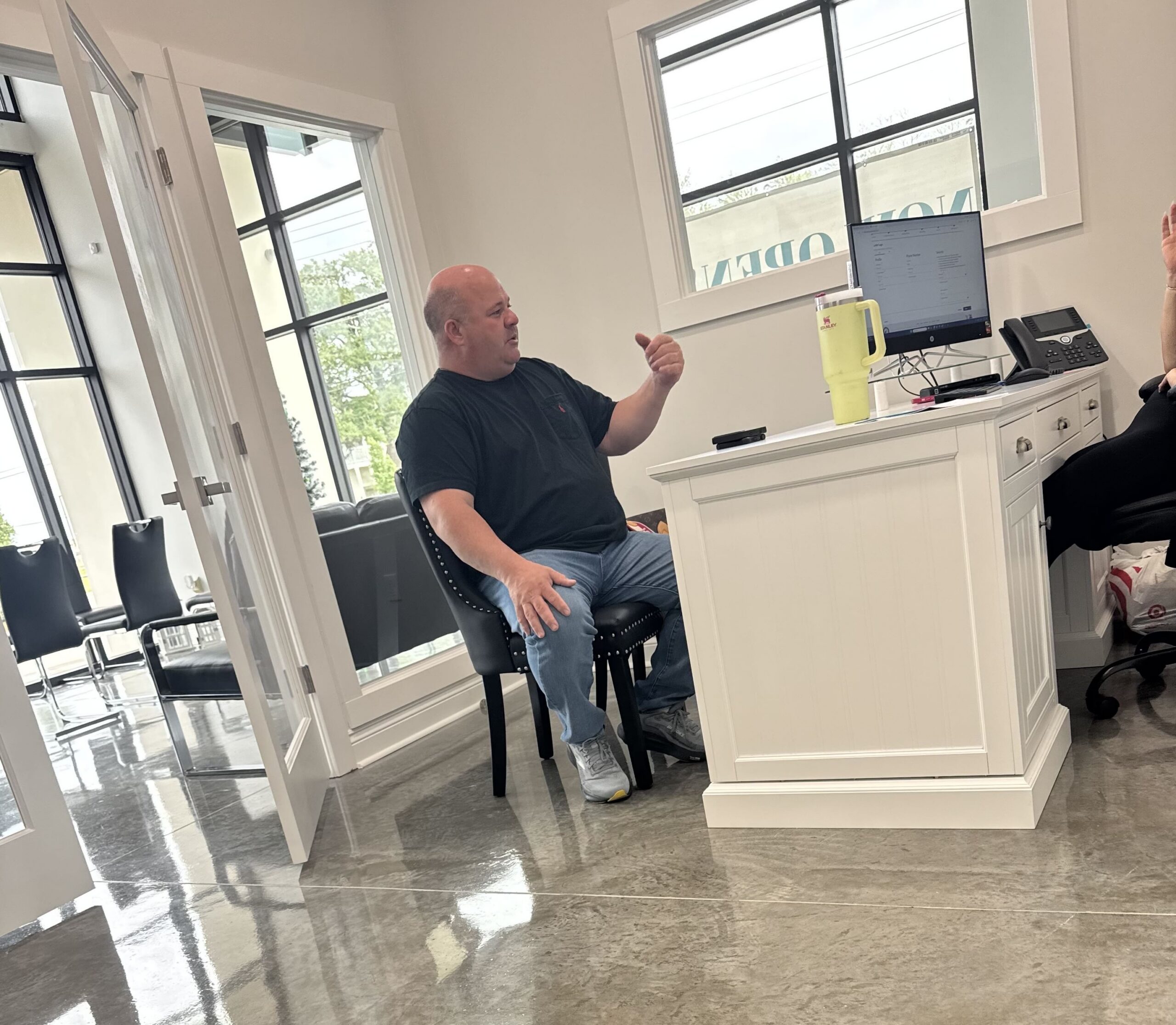
JP Broussard at Prejean Tag and Title
Dorsey was not the only member of the Criminal Investigations Division affected as the situation unfolded. Sgt. Tim Cotone, who supervised CID and Dorsey prior to her removal, was later removed himself from his supervisory position after voicing concerns about how the situation involving Dorsey was being handled.
Whether Cotone’s concerns and his subsequent removal were connected is another question worthy of examination. But it adds another personnel action involving someone with firsthand knowledge of what was occurring inside the department, and the removal of the only other full-time staff member assigned to the unit, who had been praised by Chief Broussard just weeks earlier.
Again, the Civil Service Board need not accept Dorsey’s version simply because she filed a petition. But the timeline is difficult to ignore.
- A Human Resources complaint is filed July 2, after months of being subjected to a hostile environment.
- On July 9, the Mayor warns against taking any action that would be, or could be, perceived as retaliatory.
- The transfer occurs July 10.
That is precisely the sort of sequence an independent investigation is supposed to examine.
This Is Why Civil Service Exists
Louisiana’s municipal police civil-service system was not created merely to administer employment tests and maintain eligibility lists. The law also gives Civil Service Boards investigative authority. Dorsey invokes that authority to ask the Board to investigate both the department’s personnel administration and the conduct of classified employees. Her petition asks the Board to subpoena witnesses and obtain records including printer logs, email records, postage records, and Internal Affairs files.
An investigation doesn’t take sides. At least an impartial one doesn’t. Instead, it means the evidence gets examined. Witnesses can be questioned. Documents can be obtained. Competing versions of events can be tested against the record. And eventually, somebody has to answer questions under oath.
For police officers, that principle should matter regardless of who the complainant is. A grievance procedure means very little if officers believe using it will accomplish nothing. An Internal Affairs process means very little if officers must prove their own allegations before an investigation will even begin. And civil-service protections mean very little if the body charged with enforcing them is unwilling to investigate credible allegations when they are formally placed before it.
Dorsey’s petition has now put those allegations squarely before the Civil Service Board. The question is whether the Civil Service Board will do its part.
###
Facts First. Even When They’re Inconvenient.

Some outlets or groups tell you what to think. Others have discovered there’s an easier way to build an audience: tell people exactly what they want to hear. We’ve chosen a harder path.
At Citizens for a New Louisiana, we start with the evidence — public records, financial disclosures, court filings, voting records, audits, and original documents — and follow it wherever it leads. Sometimes the facts confirm what we expected. Sometimes they surprise us. Sometimes they disappoint our friends. Either way, we publish them.
That approach doesn’t always produce the loudest headlines or the easiest fundraising. But over time, it produces something much more valuable: TRUST. If you value independent Louisiana journalism that puts evidence ahead of outrage and principle ahead of tribe, please help us continue the work.
Become a Monthly MemberContribute $10 NowMake a Tax Deductible Gift
Already have a donor-advised fund? Ask your DAF administrator about recommending a grant to New Louisiana Foundation.